

Innovation, Engineering, and Architecture department
Department Mission Statement
The Innovation, Engineering, and Architecture Department at St. Francis DeSales teaches young adults how to think analytically and creatively. Students learn how to properly draft and design using CAD, computer aided design, and make scale models. Through these projects they work on team building exercises, explore lifelong learning, take educational risks and believe in themselves. The curriculum covers technology, professional careers, equipment safety, and critical thinking skills. Students have continued these skills in fields such as: construction, engineering, architecture, animation, and various technology professions.
DEPARTMENT CHAIR - Kim Gattis - gattis@desales.co
INNOVATION, ENGINEERING, AND ARCHITECTURE DEPARTMENT teacher
-

kim gattis
Department Chair
Architecture
Adv. CADD/Prod. Design
Intro to CADD
Intro to Engineering
Mechanical and Structural Engineering
INNOVATION, ENGINEERING, AND ARCHITECTURE DEPARTMENT courses
Intro to CADD - 0703 (.5 year)
Prerequisite: None
Grade: 10-12
Elective Credit: 0.5
Intro to CADD (Computer Aided Drafting & Design) teaches the first of two industry led software programs for Architecture, Industrial Design, and Engineering. Through a series of projects, students will gain a basic understanding of each of the systems, their similarities and differences, and applications for both. Their passage through this course is documented through a portfolio.
Introduction to Engineering - 0733 (.5 year)
Prerequisite: None
Grade: 9-11
Elective Credit: 0.5
This course teaches the fundamentals of the engineering design loop, a problem-solving process focused on the end user. Content will include idea generation, model building, and using teamwork to solve Architectural, Design, and Engineering challenges. Projects will include cardboard chairs, Rube Goldberg machines, and package design—no CADD experience is required for this course. Students will be using hand and machine tools to construct their projects.
*Note: Future PreReq to the Engineering Classes
Mechanical and Structural Engineering - 0734 (.5 year)
Prerequisite: Introduction to Engineering
Grades: 10-12
Elective Credit: 0.5
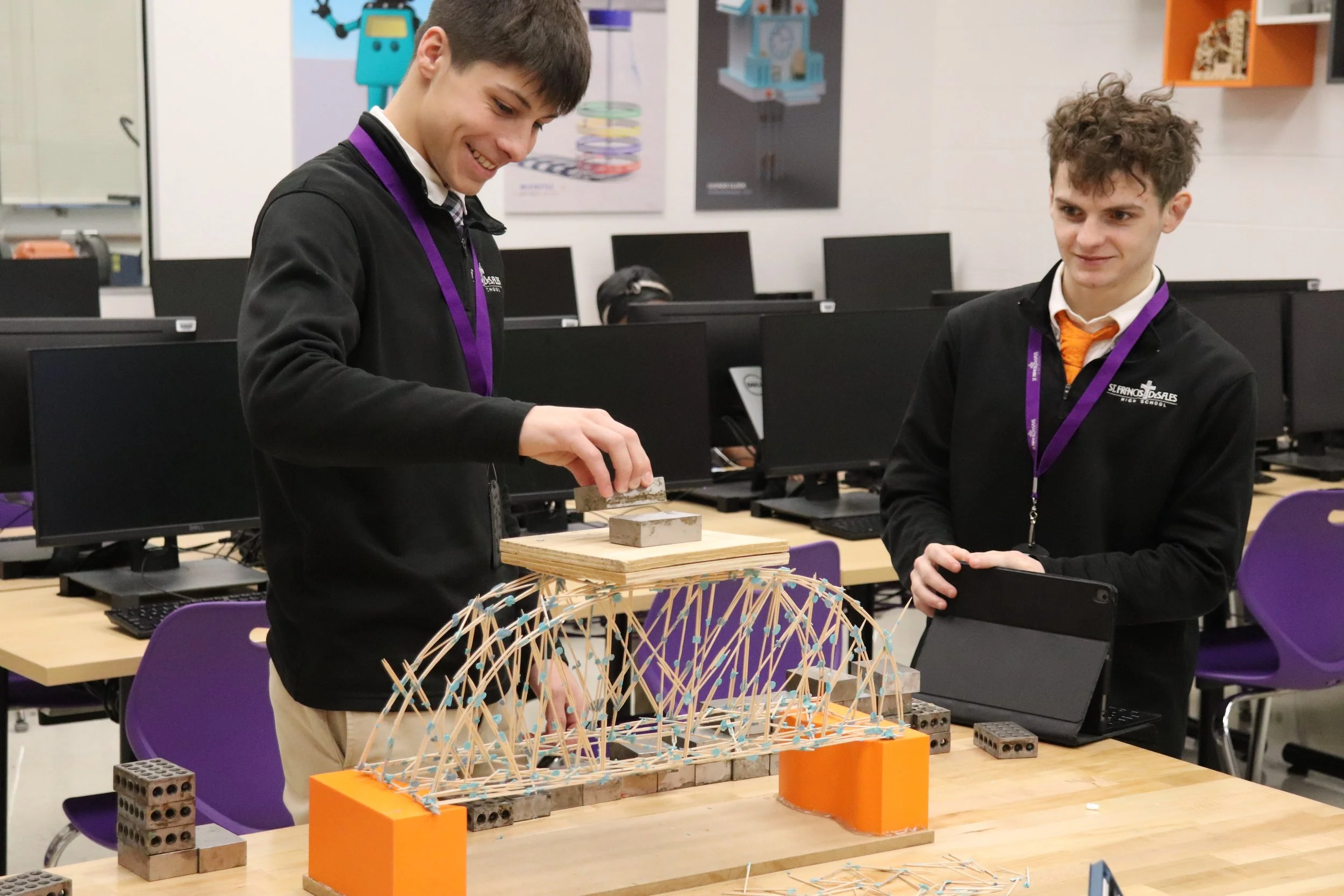
One of the oldest forms of engineering, mechanical engineering encompasses everything from bicycles to animatronics. In this class, students work with vehicles, siege machines, bridges, and other hands-on projects to understand the engineering design process, determine the application of forces, and basic data collection. Along the way, they learn and apply an understanding of potential energy, mechanical advantage, acceleration, and more.
Electrical and Computer Engineering - 0735 (.5 year)
Prerequisite: Introduction to Engineering
Grades: 10-12
Elective Credit: 0.5
As the world becomes more automated, this Electrical and Computer Engineering course provides the student with a broad overview of electrical basics to apply to the Internet of Things. Topics include the electric circuit, solving circuits, measuring electricity, and electricity standards. Students will utilize solderless circuitry, Arduino technology, and virtual circuit design software to solve human/machine interface systems, distributed control systems, and embedded microcontroller systems.
Architecture – 0721 (1.00 year)
Prerequisite: Intro to CADD
Grade: 10-12
Elective Credit: 1.00
Architecture is a yearlong course which teaches students how to create an architecturally correct floor plan and design interior spaces. Students will use CADD as they enthusiastically design for the future. Projects will include; residential (housing) and commercial (public/business) architecture, architectural history, mechanical drafting, animating tours through spaces, presentation drawings, and constructing scale models.
Adv. CADD/Product Design – 0730 (0.5 year)
Prerequisite: Intro to CADD
Grade: 10-12
Elective Credit: 0.5
Advanced CADD (Computer-Aided Drafting & Design) teaches the second industry-led software program for Industrial Design and Engineering focusing on desktop and mobile applications. Through a series of projects, students will learn the basic functions and construction techniques on each. Additionally, the students will utilize all of the fabrication equipment in the lab and gain an understanding of the appropriate usage for each. Their passage through this course is documented through a portfolio.